


Fellowship, today I’m thrilled to bring to you an interview I conducted recently with the great Tolkien artist Matěj Čadil. His answers to my questions are thorough and fascinating and offer a special insight into the mind of someone who is at once a great artist, a lifelong Tolkien fan and a devout Catholic. Enjoy, and please support Mr. Čadil at the venues he lists below! (All images by Matěj Čadil.)
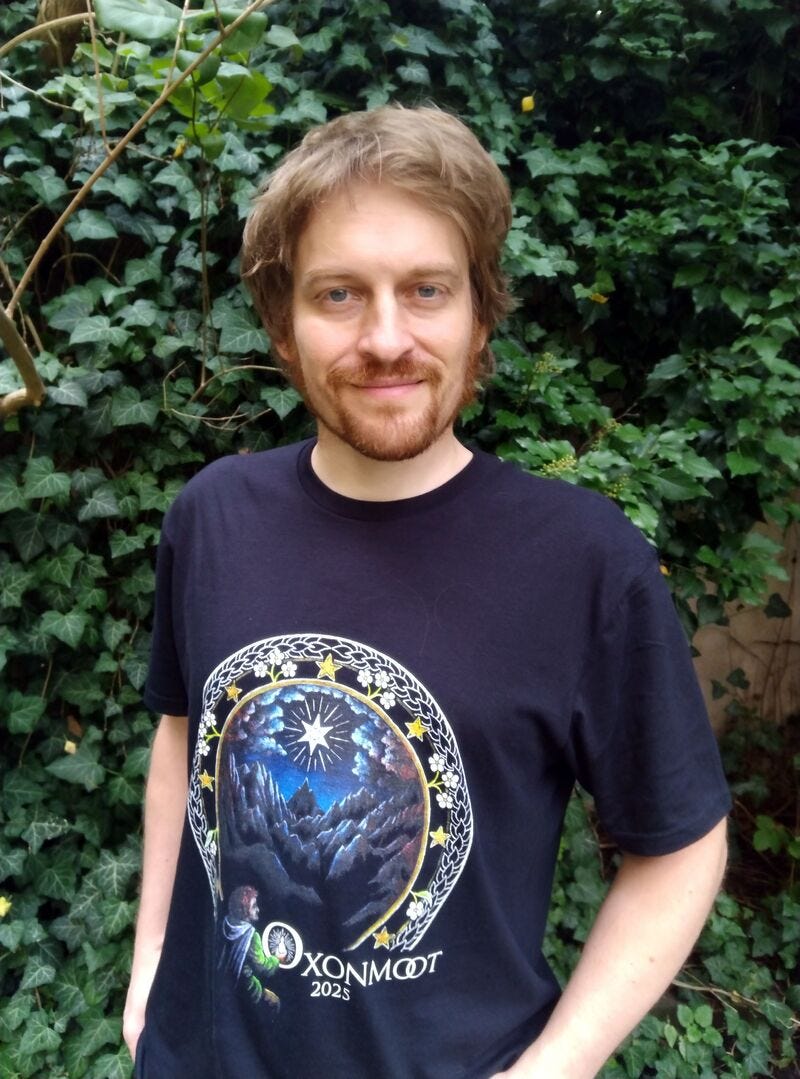
Kaleb Hammond: Thank you for agreeing to this interview for Saint Tolkien, Mr. Čadil. To start, please tell us a little about yourself. Have you always been a fan of Tolkien’s legendarium?
Matěj Čadil: I’m a Czech artist living in the beautiful city of Prague with my wife and our three children. Tolkien has been part of my life since childhood. My first encounter with Middle‑earth came when my dad read The Hobbit aloud to me when I was about nine. After that The Lord of the Rings and even The Silmarillion. Hearing those stories made a deep impression on me: the landscapes, the languages, the sense of ancient history behind everything. It felt like discovering a world that had always been waiting for me.
I kept returning to the books as I grew older, first in Czech translation and later in English, and gradually sought out everything Tolkien wrote, from Unfinished Tales to the volumes of The History of Middle‑earth.
Hammond: Your portfolio of Tolkien-inspired artworks is prolific. How did you first get into making illustrations for Tolkien’s world?
Čadil: I’ve been drawing since childhood, especially landscapes, architecture, and maps. When I discovered Middle‑earth it was so vivid in my imagination that it felt completely natural to try to draw it too.
As a teenager in the early 2000s I began sharing some of those early drawings online, both on my own website and on the art platforms of the time. The positive reactions from other Tolkien fans encouraged me to keep going and to take the work more seriously.
An interesting thing about my early illustrations is that for a long time I avoided the more famous scenes. I didn’t feel confident drawing characters, and I certainly didn’t want to compete with the great Tolkien artists whose work I admired. So I often chose more obscure places and details in Middle‑earth that had not been illustrated before.
Hammond: Your art, for Tolkien and otherwise, is intricately detailed, vividly colored and masterfully designed. How did you learn to draw and paint with such skill?
Čadil: I’m largely a self‑taught artist. I never attended an art school (only briefly some courses), but I simply kept practicing since childhood, sketching constantly, studying the world around me, and learning through observation and trial and error. I think my skills just grew slowly over time, shaped by patience more than anything else.
I’ve always been drawn to landscapes, architecture, and ornamental art, and those interests naturally influenced the way I learned to draw and paint. Another important part of my growth has been my wife’s encouragement. She helped me step outside my comfort zone, especially when it came to drawing characters, which I avoided for many years.
Hammond: One of my favorite aspects of your art is your use of architectural borders and inscriptions, often in Tolkien’s runic scripts, which remind me of medieval manuscript illuminations. Are there any artists or styles in history that have been particularly influential for you?
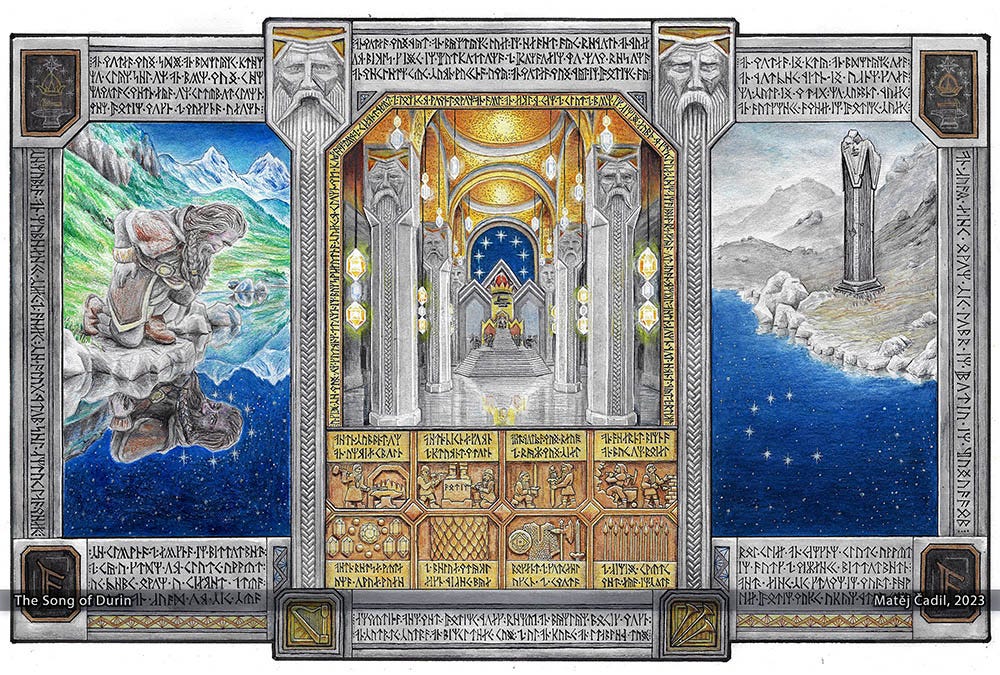
Čadil: I have always loved the sacred art of medieval Europe. I admire Romanesque and Gothic churches, their architectural ornament, and the visual language that grew around them. I love medieval manuscript illumination and I’m also very fond of Celtic art and calligraphy, with its intricate knotwork ornaments.
Old maps have been another source of inspiration, especially portolan charts, with their elegant lines and symbolic geometry.
I love Pre-Raphaelite art, as well as the ‘golden age of illustration’ spanning from the late 19th to the early 20th century.
One influence that is perhaps less well known is the Beuron Art School, a sacred art movement developed by Benedictine monks in the late 19th century. Its style, shaped by ancient Egyptian and medieval models, has a serene, timeless quality. Beuronese art was used especially for church murals and illuminated books, and it later influenced Art Nouveau and Art Deco. I’ve always admired its balance and stylization.
Hammond: Your beautiful artworks showcase a wide variety of styles and materials. How would you describe your approach to making Tolkien illustrations? Do you have a favorite medium for Tolkien art?
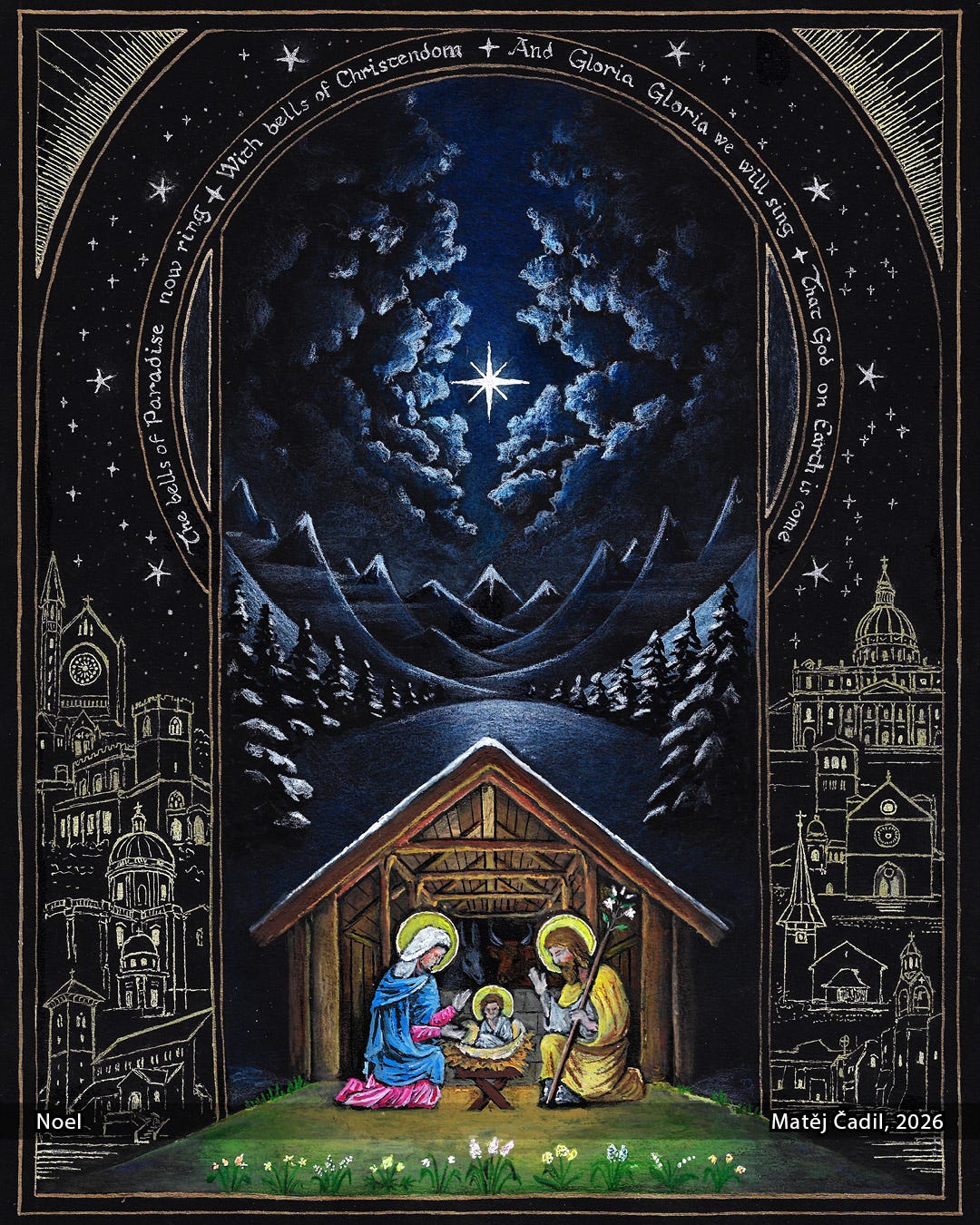
Čadil: My approach to Tolkien illustration often begins with choosing the medium that best suits the mood of a scene. Sometimes the choice is simply practical. Drawing with pencil or ink liners is easier to fit into a busy day, and I’ve made many smaller ink pieces (especially during the Inktober art challenge which naturally encourages that medium).
But in general, I find that different scenes seem to “ask” for different materials. When I’m working with detailed architecture, ink line art feels right because it allows me to capture every small element with clarity. Colourful ornamental designs work beautifully with coloured pencils. Lush natural landscapes often call for oil pastels or gouache. Darker scenes sometimes work best on black paper, where the highlights emerge like light out of shadow. And so on.
So my approach is quite intuitive: I try to match the medium to the character of the scene.
Hammond: Your art has received multiple awards from the Tolkien Society and has been praised by fans and fellow artists alike for your faithfulness to Tolkien’s works. How important is it to you to make your illustrations accurate to Tolkien’s original stories?
Čadil: Faithfulness to Tolkien’s world is very important to me. In his work, he sought inner consistency in reality and I believe that accurate illustrations are an excellent way to honour that.. I see my role as an illustrator not to reinvent Middle‑earth, but to illuminate what is there, to help viewers visualise the text and only introduce my own ideas in moderation. Like when Gimli explains to Legolas how he would care for the natural beauty of the Glittering Caves.
In practice, that means careful reading of the passages I’m illustrating, paying attention to every detail Tolkien gives. I often cross‑reference details from his other writings, or look to real‑world historical sources when something in the story suggests a particular connection.
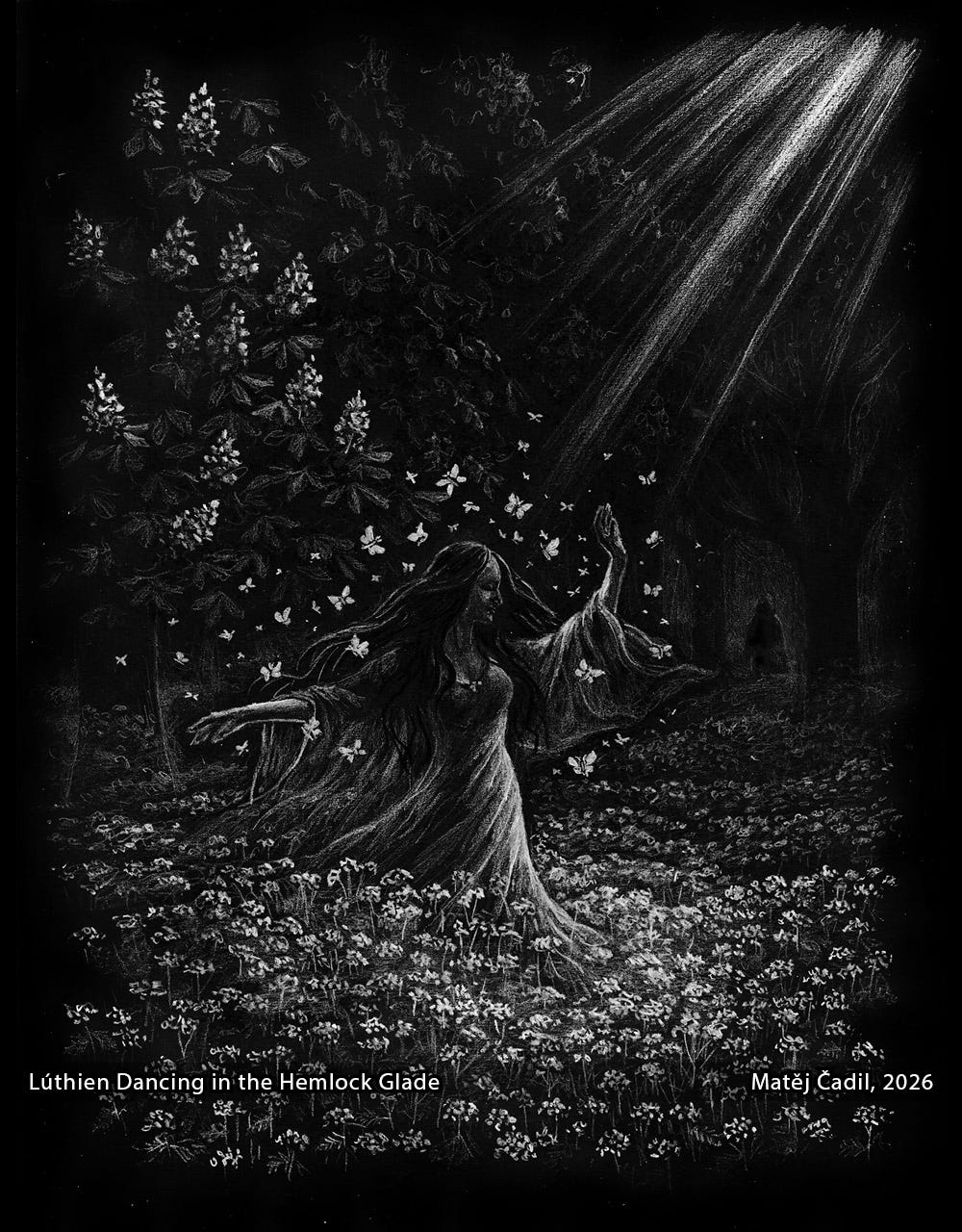
At the same time, accuracy doesn’t mean rigidity. The text provides a solid foundation, but there’s still room for interpretation and filling in the blanks.
Hammond: One of the most common figures featured in your Tolkien illustrations is Bilbo Baggins. Would you say that he is your favorite character? What about him do you find inspiring?
Čadil: Bilbo is certainly one of my favourite characters. I love his ordinariness, his love of home and simple joys, and the way he grows from comfort into courage without ever losing his humility and kindness.
I also love the way his story continues after the adventure. He becomes a writer, a poet, a keeper of lore, and he inspires the younger hobbits who come after him.
From an artistic point of view, his journey is a delight to illustrate. It takes him through so many varied landscapes and it offers endless possibilities for an illustrator.
Hammond: Your Tolkien art is similar in many respects to Tolkien’s original illustrations for his world. How have you been inspired by Tolkien’s drawings and paintings in your work?
Čadil: That’s the kind of praise that always delights me the most. In a sense, I think I have similar artistic inclinations to Tolkien: Like he, I find that landscapes and architecture come more naturally to me than characters.
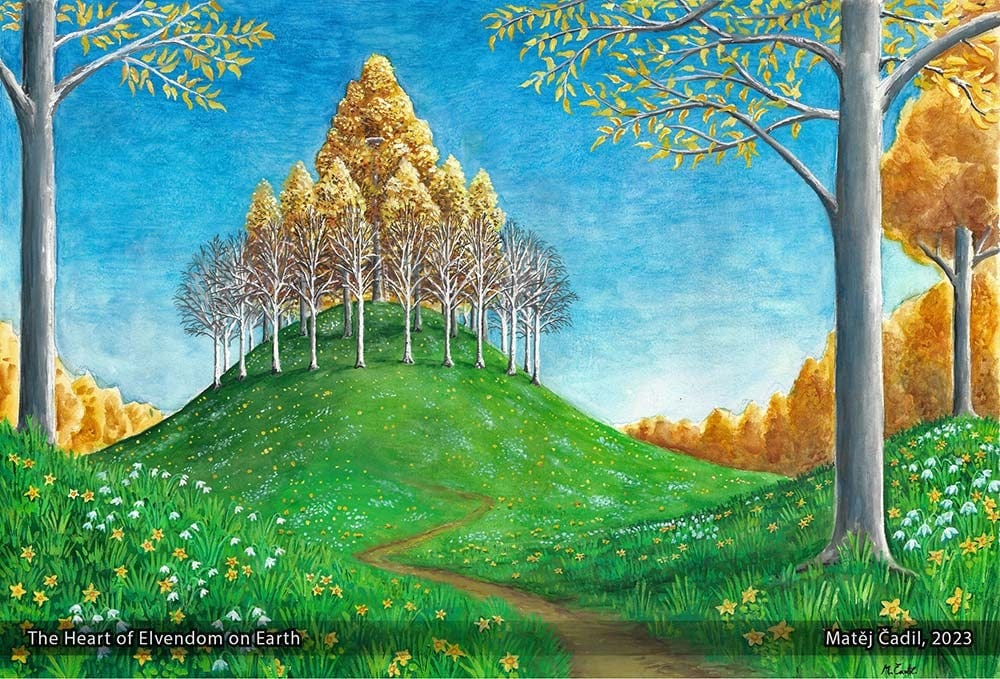
His illustrations are also my primary visual reference. They offer invaluable clues about how he imagined his world. I usually don’t try to imitate his style, but I like to think of my work as standing in a kind of continuity with his, developing what he sketched in my own way.
Hammond: As well as being a fan of Tolkien’s fiction, you also share his Catholic faith. How has Catholicism shaped your artwork and your writing?
Čadil: I didn’t grow up religious; I came to the Catholic Church as an adult. But even as a child, I was drawn to church architecture and sacred art. In old churches, I was filled with a sense of reverence. Living in a historic city full of beautiful churches, I found myself proud of the heritage of Christian art and it was its beauty that first drew me closer to faith.
My Catholic faith certainly shapes how I see beauty and meaning. It gives me a sense of the world as ordered, purposeful, and sacramental, a place where visible things hint at deeper realities. I think that perspective certainly influences my artwork: the idea that beauty is something objective and worth striving for, and that creating art is, in a small way, participating in God’s own creative act.
Hammond: In your Substack articles, you have explored multiple themes related to Tolkien’s Catholicism, including his concept of eucatastrophe and the Catholic symbolism in his stories. What role has Tolkien’s Catholicism played in your own faith?
Čadil: Tolkien’s stories always felt “right” to me in a way I couldn’t fully explain. Long before I seriously considered Christianity and before I even knew Tolkien was Catholic, his understanding of providence, the hope that runs through his stories, and the joy of eucatastrophe all shaped how I saw the world.
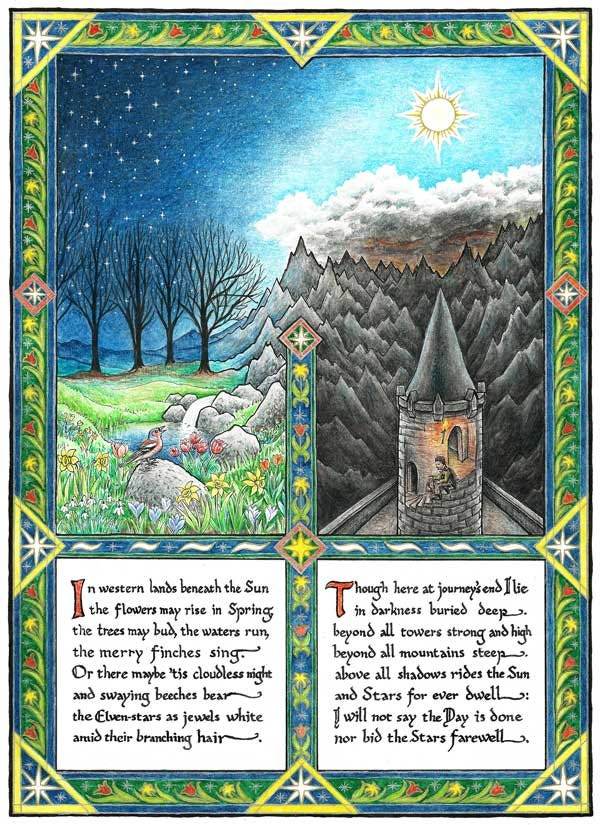
Although Tolkien’s books weren’t the only thing that moved me to Christian faith, they played a significant role in preparing my heart.
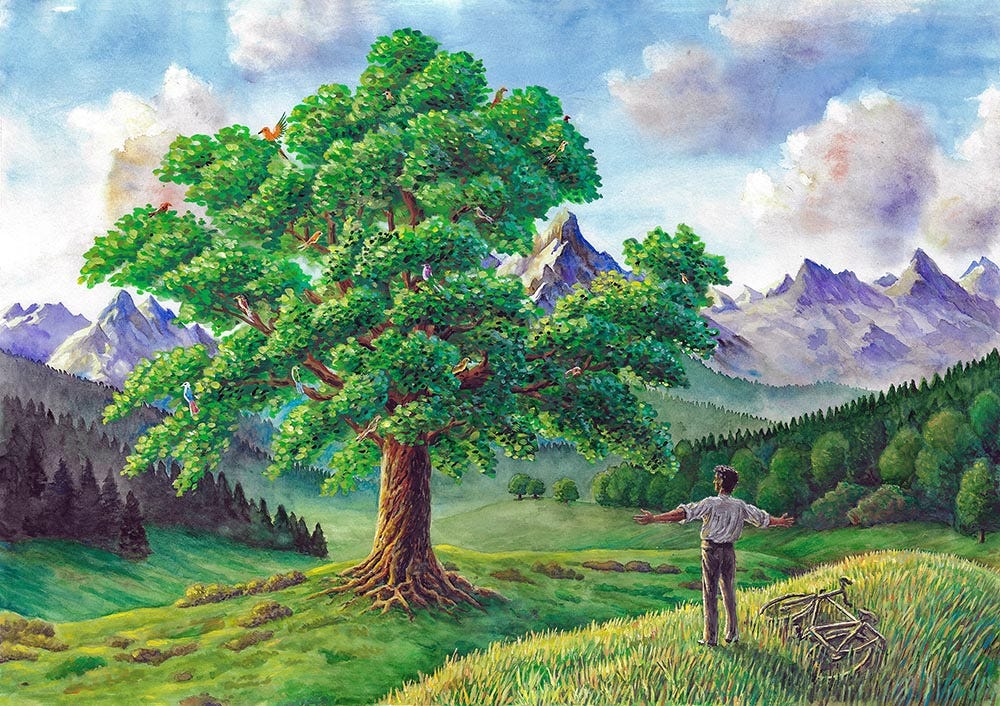
Reflecting on Tolkien’s themes later in my writing helped me understand my own beliefs from a new angle. And not only his Middle‑earth legendarium: his essay On Fairy‑Stories, with its thoughts on sub‑creation, gave me a new perspective on art as a kind of vocation. And Leaf by Niggle remains one of the most beautiful Christian allegories I have ever read.
Hammond: Since the early 2000s, you have been actively involved in the international Tolkien community, including the Tolkien Society and its Oxonmoots and Westmoots, for which you have designed several t-shirts, as well as the Beyond Bree calendars, the annual TolkienCon in Prague and other events. How important has the international Tolkien community been in your work as a Tolkien artist and writer?
Čadil: In the early 2000s I found my first Tolkien friends online, fellow artists on various art sites, and I also attended a few local events like TolkienCon in Prague. But at that time I wasn’t very active in the wider community; it was more of a personal passion.
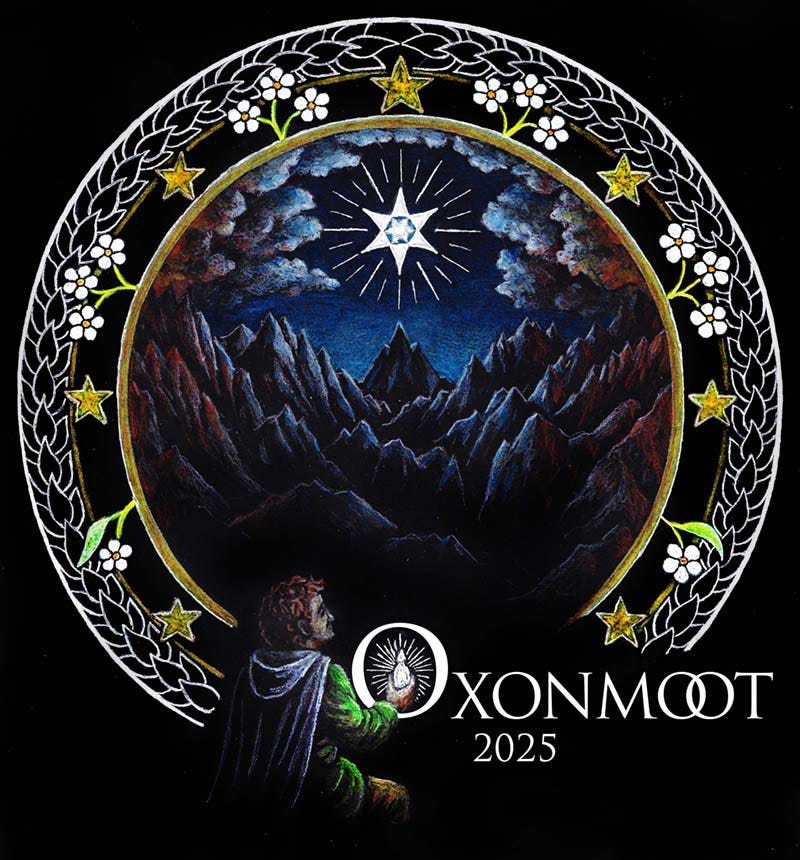
That changed in the last five to ten years. A large part of the credit goes to the Prancing Pony Podcast, which I completely fell in love with. It inspired me to attend their first online moot in 2022, and that experience encouraged me to join the Tolkien Society and take part in their moots online. And this year I’m going to Oxonmoot in person for the first time. Similarly to Tolkien himself I am hobbit-like in that I don’t travel much, so this feels like a milestone.
What I appreciate most is the warmth of the community: the friendships, the encouragement, and the creativity it fosters. There are so many knowledgeable people. Reading all the articles, listening to podcasts, and simply talking with other fans online has deepened my understanding of Tolkien and enriched my work as an artist enormously.
Hammond: You are also the owner of the Czech-language website Angrenost.cz dedicated to Tolkien. Could you tell us more about it?
Čadil: Angrenost.cz is one of the oldest Czech Tolkien websites. Over the years it has grown into a fairly comprehensive resource, especially with its Tolkien encyclopedia and Quenya dictionary, along with essays and other materials for Czech readers.
I made it in 2001, when the first Peter Jackson film came out, and suddenly everyone was creating blogs and websites about the movie. I regarded myself as one of those people who knew The Lord of the Rings before the it was cool, so I decided to make a website strictly about the books. I wanted it to have original illustrations, and since I didn’t have any, I simply started drawing them myself.
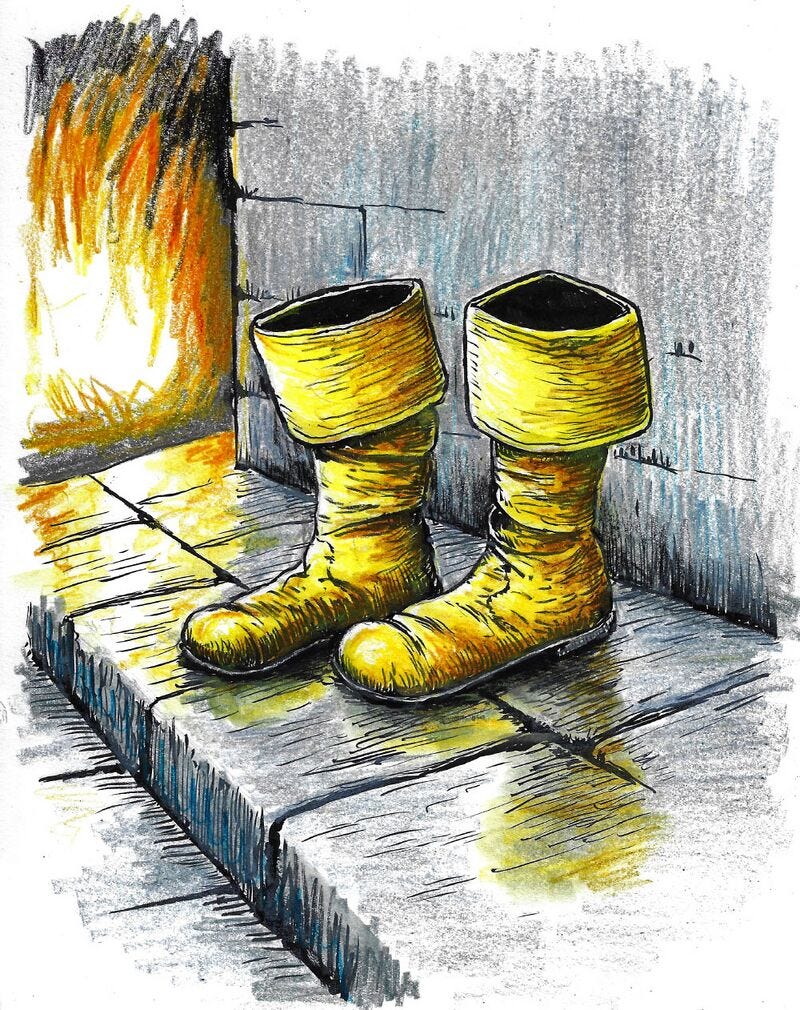
In that sense, Angrenost.cz is intertwined with the very beginning of my artistic journey.
The site evolved over time and went through several phases and rebuilds. For a while it was a lively hub for Czech Tolkien fans, with an active discussion forum and a news feed. As people moved to social platforms, the community aspect faded, also I don’t have as much time to devote to it as I once did. But it remains a solid source of information, and after almost twenty‑five years I still take pride in keeping it alive. It’s a small piece of Czech Tolkien history, and I’m glad it continues to serve readers.
Hammond: Your Tolkien art is featured heavily in Tolkien publications and on the fan site Tolkien Gateway, alongside many other great Tolkien artists. Do you have any favorites among your fellow Tolkien artists?
Čadil: There are so many wonderful Tolkien artists whose work I admire. Among the big names, Ted Nasmith is closest to my own sensibilities, I love his landscapes, his vibrant colours, and his faithfulness to Tolkien’s descriptions.
I greatly admire Anke Eißmann for her elegant linework and historical aesthetics, and Jenny Dolfen for her beautiful, expressive character portraits. Miriam Ellis is a friend whose work is wonderfully accurate to Tolkien, deeply rooted in the natural world, and full of beautiful light. I also appreciate Elena Kukanova for her striking portraits, and Jay Johnstone for his historical inspiration and ornamental design. And of course Lída Holubová, a fellow Czech artist and friend, whose distinctive personal style I admire very much.
I feel honoured to have my work shown alongside artists like these. Their creativity enriches the world of Tolkien art, and I’m grateful to be part of that artistic community.
Hammond: You and I are close to the same age. Peter Jackson’s film trilogy in 2001-2003 was my first direct encounter with Tolkien, and I began reading the books during the intervening time between the films. What role have Jackson’s films played in your love of Tolkien and your Tolkien-inspired art?
Čadil: As I mentioned before, I was already a devoted reader and proud to be one who loved The Lord of the Rings before the films, but the release of the film trilogy created a wave of excitement that drew me deeper into Tolkien’s world. I really disliked certain changes Peter Jackson made, but I loved the films in general.
In my visual art I’ve always tried to stay close to my own mental image or Tolkien’s descriptions and illustrations, and prefer those to the film adaptations. But the films definitely had an influence on me; for example, the architectural design of Rivendell or Minas Tirith significantly shaped my own vision.
Hammond: Your love for your Czech culture and homeland is palpable throughout your work and in your Substack notes. How have the rich culture and beautiful landscapes of the Czech Republic influenced your art and writing?
Čadil: The places I grew up in certainly formed my eye long before I thought of myself as an artist. I love the cultural landscape that has been lived in for centuries, the gentle hills, small villages, and old countryside churches, as well as the historic streets and spires of Prague.
This naturally flows into my Tolkien‑inspired work. The landscapes I imagine for the Shire are often based on my experience of Czech countryside; my idea of beautiful architecture owes a great deal to our rich Gothic and Baroque heritage.
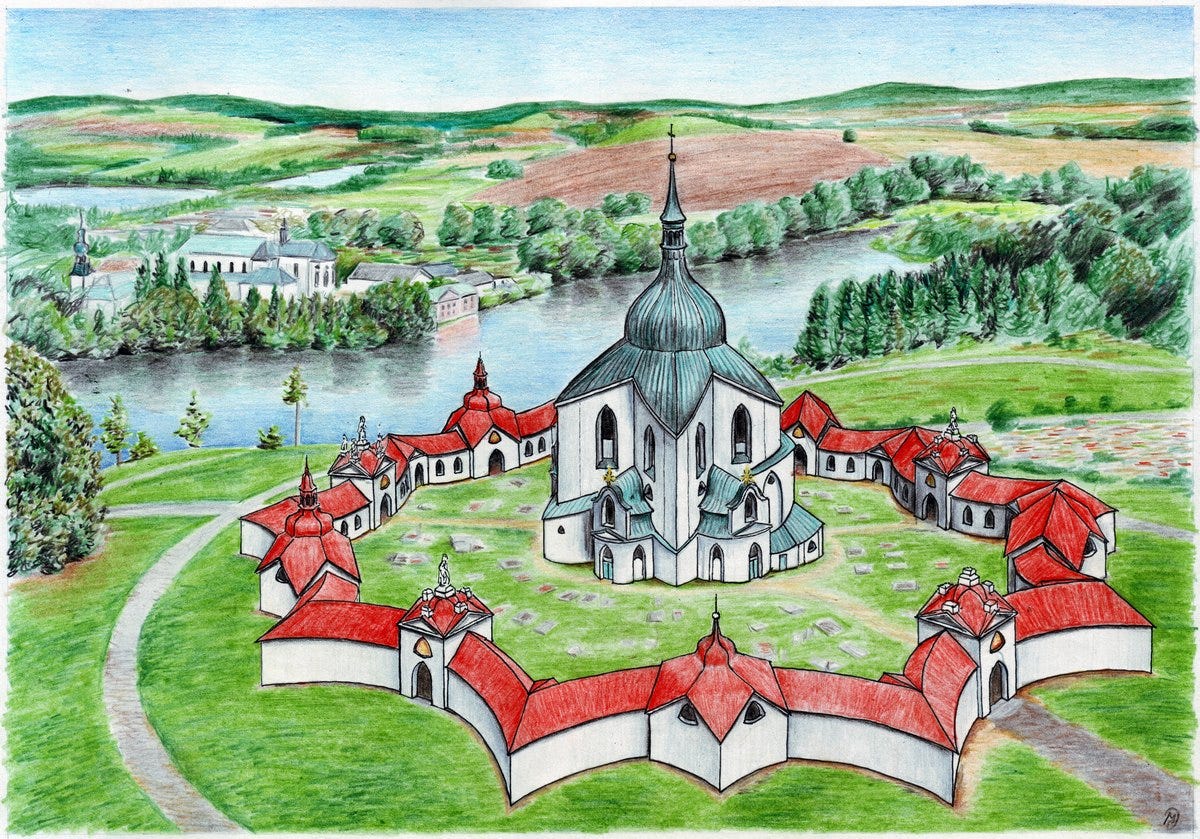
Though I certainly love other parts of Europe as well, such as Italy, where I find inspiration for Gondor.
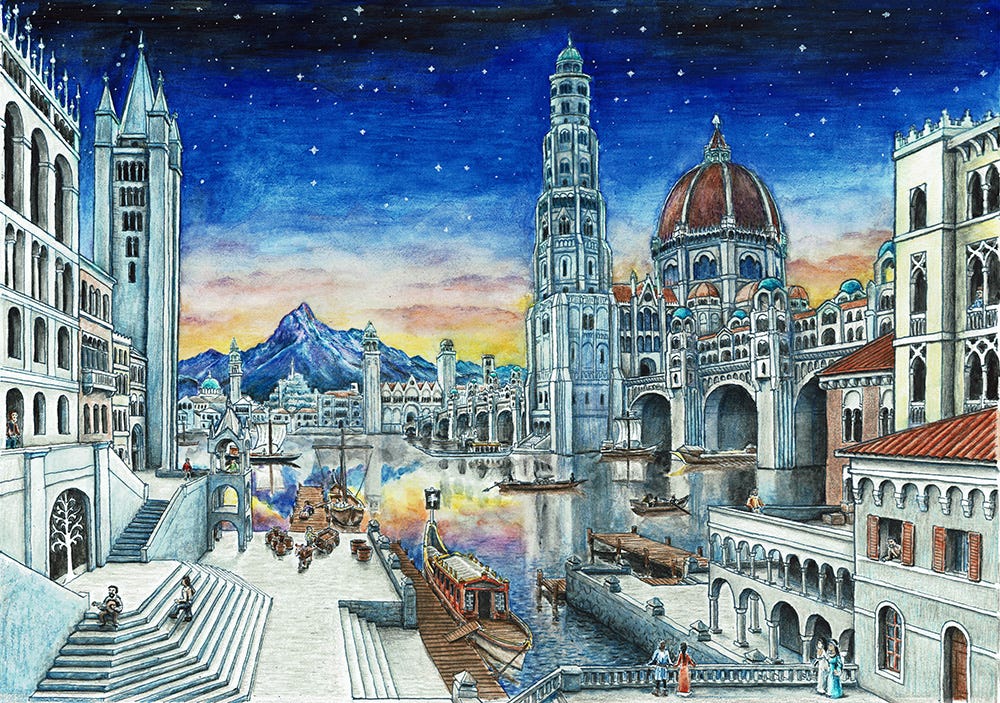
In my Substack writing, I try to let my life in the Czech Republic and my vision of Tolkien’s world illuminate each other. I hope my experience of life in the particular corner of the world God has placed me in, this small, beautiful country at the heart of Europe, can bring something interesting to other Tolkien fans around the world.
Hammond: Thank you again for agreeing to this interview, Mr. Čadil. To conclude, could you tell readers where they can find your art and how they can help support it?
Čadil: Thank you. I’m grateful for everyone who takes an interest in my work.
You can certainly visit my Substack, Visions of Middle‑earth, where I share new art and essays. I’m also active on Instagram and Facebook, and for those who want to support my work more directly, there’s my Patreon and my Etsy shop with my art prints and originals.
And truly, thank you to everyone who walks this road with me.
Hammond: Finally, do you have any upcoming projects you would like to share with us?
Čadil: My main ongoing project now is my illustrated read‑through of The Hobbit: creating an artwork for each chapter and writing the accompanying essays on my Substack, Visions of Middle‑earth. The plan is to continue steadily until all the chapters are complete.
I also have several other illustration projects and collaborations quietly in progress, which I’ll be able to share in due time. And I want to add that I’m open to commissions and illustration work, whether Tolkien‑related or not. If anyone would like to discuss a project, a book, or a personal piece, I’m always happy to hear from them.
I’m grateful for everyone who follows along, and I look forward to sharing more as these projects unfold.
Check out great Catholic comics - and a new book I contributed to, Batman & Faith - and get 10% off your order at Voyage Comics when you use this link!
Cor Jesu Press is a Catholic publisher recovering forgotten classics. Help promote their important work!
 | A guest post by
|
I enjoyed this very much!